
The story of the intriguing and mysterious giant, perfectly symmetrical crater that sits in the Arct

Also known as the Crystal Eye, it bears a striking resemblance to a perfectly symmetrical indigo-blue eye. This impressive crater is considered a unique natural treasure.

The crater represents a "scar" from the Pleistocene - Photo Reproduction/Robert Fréchette/Kativik Regional Government
The Pingualuit bowl, located in the province of Quebec, Canada, is one of the most impressive and intriguing places in the world. About 3.4 kilometers in diameter and 400 meters deep, the crater It is considered one of the largest impact craters on the planet.
Crater
About 3.5 km in diameter and 270 meters deep, Pingualuit Crater is located in the North Island, Canada. Your background is estimated to be 1.4 million years old, the result of the impact of a huge meteorite that fell on the site. The fireball was so powerful that it created a crater. almost perfectly symmetrical. Pingualuit continues to be used to this day as a tool to study past climate.
For the Inuit people, who have lived near the crater for over 2,000 years, the site is sacred and its existence is surrounded by legends and myths. The crater which is also called by the peoples of the Arctic, the “crater”Crystal Eye” (“Olho de Cristal”), is surrounded by crystalline freshwater waters and beautiful natural landscapes, with an area of environmental protection for the preservation of the region, which makes it even more special.
Studies
Pingualuit is one of the most recent geological discoveries in human history and has become known as a unique natural treasure. This place is the only one in the world where it is possible to contemplate the original meteorite rock, called anorthosite, a formation rich in silicon and aluminum. Seen from above, the Crater resembles an indigo-blue eye of perfect symmetry. Due to its dimensions, it is speculated that the meteorite responsible for its formation had an impact with a force equivalent to 8,500 energy bombs.
Pingualuit crater is a true natural laboratory for scientists to study the Earth's history and evolution. Since it was discovered in 1943, scientists have struggled to understand the formation and evolution of this crater, as well as the geological and biological characteristics of the region around it.
Intensive scientific studies that were carried out at the site revealed that the crater formed during a period of geological transition, when the surface of the planet was experiencing great instability. Currently, the region continues to be the object of studies covering several areas, such as geology, hydrology and biology.

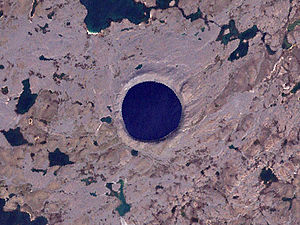

The crater is also known as Pingualuit Crater - Photo Reproduction/satellite/Wikipedia
There is one intriguing mystery behind this natural wonder. The crater surprises scientists due to its disconnection from bodies of water, despite Pingualuit National Park having several smaller lagoons that surround the ground around the "Crystal Eye". However, these ponds are not directly connected to the crater. As a result, it is highly likely that the crater retains its prehistoric conditions, uncontaminated by outside influences.
Tourism
The Pingualuit crater represents an impressive geological formation and is an invaluable treasure for the study of Earth history and science in general. In addition to being an important geological research area, the crater also plays an important role in tourism in the region. Many travelers seek to know the place for its natural beauties and for its historical and scientific importance.
Pingualuit National Park, established in 2004, offers visitors the opportunity to see the beauty and rarity of this unique geological formation up close. The park includes a series of trails and viewing platforms that allow visitors to get panoramic views of the crater and surrounding region. However, the preservation of Pingualuit Crater becomes a crucial concern. Increased tourism and mineral exploration in the area has put pressure on the crater's fragile ecosystem.


