
Russian spacecraft Luna-25 crashes on moon after spinning out of control, officials say

The Russian agency said the spacecraft spun in an unpredictable orbit before managing to land as planned. This lunar mission represents Russia's first venture towards the Moon in nearly half a century.
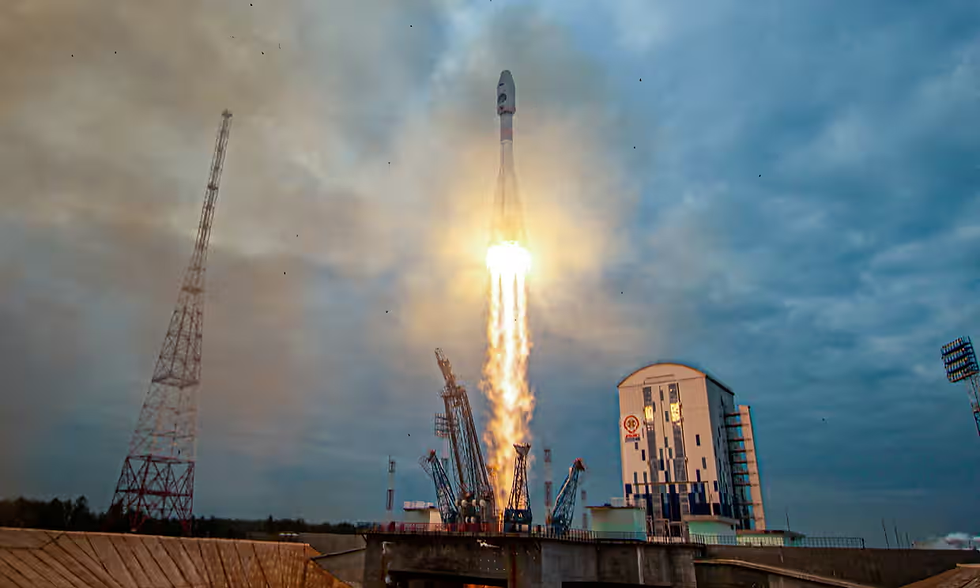
The Luna-25 spacecraft took off from Russia's far east on August 11.
Russia suffered a major setback on its first lunar mission in 47 years, when his unmanned spacecraft Luna-25 lost control and collided with the moon. This incident represents a significant blow to the Russian space program, which sought to regain the prestige gained in the Soviet era.
A Roscosmos, Russian state space agency, reported this Sunday morning (20), that communication with the probe was lost on Saturday afternoon at 2:57 pm in the country time (8:57 am in Brasilia time), due to a problem that occurred while the ship was on its approach orbit for landing. Originally, a soft landing was scheduled for Monday, (21).
"The craft entered an unpredictable orbit and ceased to exist as a result of a collision with the moon's surface," the agency said in a statement.
Roscosmos also informed that a special interdepartmental commission was established with the purpose of investigating the causes of the loss of the Luna-25 spacecraft.
Russian space program
The loss of the Luna-25 mission represents a heavy blow to the Russian space agency, Roscosmos. Russia's civilian space program has faced a notable decline in recent years, as state resources are increasingly directed towards military purposes. This happened just when Russia was in a space race with India, whose Chandrayaan-3 spacecraft was about to land at the south pole of the Moon in the coming days. The Indian mission plans to send a rover to explore the rock formations and craters, collecting data and images to transmit back to Earth.
The Russian space probe Luna-25 was conceived for the purpose of exploring a region of the Moon which scientists believe contains frozen water and valuable resources. Pavel Luzin, an expert on the Russian space program, had previously claimed that the success of the Luna-25 mission It was essential to demonstrate that Russia still had the capability to perform space feats, such as a lunar landing mission, independently of the West and after numerous failures in the past, changes of generations of experts, delays due to attributes imposed by the West and the current isolation resulting from its involvement in the war in Ukraine.
According to him the failure of the mission clearly highlighted the decline of Russian space power since the heyday of the Cold War competition, when Moscow reached historic milestones, such as the launch of the first satellite to orbit the Earth, Sputnik 1, in 1957, and the trip of the Soviet cosmonaut Yuri Gagarin, who became the first human being to travel into space in 1961.
Space race
Russia is facing competition from India, whose Chandrayaan-3 space probe is scheduled to land at the south pole of the moon this week, in addition to competing more widely with China and the United States, both with advanced lunar ambitions. The Indian Space Research Organization (ISRO) announced that India's Chandrayaan-3 is due to land on the moon on August 23 via a Twitter post.
Anatoly Zak, the creator and editor of the Russian Space Web site, which monitors Russian space programs, described the flight control system as a vulnerable area that has many fixes. Zak noted that Russia also opted for a much more ambitious moon landing mission before carrying out a simpler orbital mission, following common practice in the Soviet Union, United States, China and India.
A representative of Indian Space Agency ISRO lamented the incident involving the Luna-25 lunar probe, classifying it as an unfortunate event. He stressed that all space missions are highly risky and complex, making it all the more sad that Luna-25 has struggled. The Russian agency Roscosmos, for its part, had already recognized the risk associated with the Luna-25 mission and the possibility of failures.
The probe was successfully launched in the Cosmodromo de Vostochny, located in Russia's far-eastern Amur region, in Aug. It successfully reached the Moon's orbit on Wednesday of this week. The spacecraft was expected to make history by making a soft landing on Monday or Tuesday, just days before its projected mission to India.
It is important to note that no country had managed to land successfully on the south pole of the Moon until then, although the United States and China had already carried out controlled landings on other parts of the lunar surface. The Luna-25 mission marked the first Russian foray to the Moon since 1976, when the Soviet Union was active in lunar exploration. It is worth remembering that this mission, Luna-24, had a successful landing.


