
New York adrift: Research reveals the metropolis is sinking under the weight of its skyscrapers

Each year, the city is experiencing an average subsidence of approximately 1 to 2 mm, which exacerbates the effects of rising sea levels and poses a growing threat of flooding.
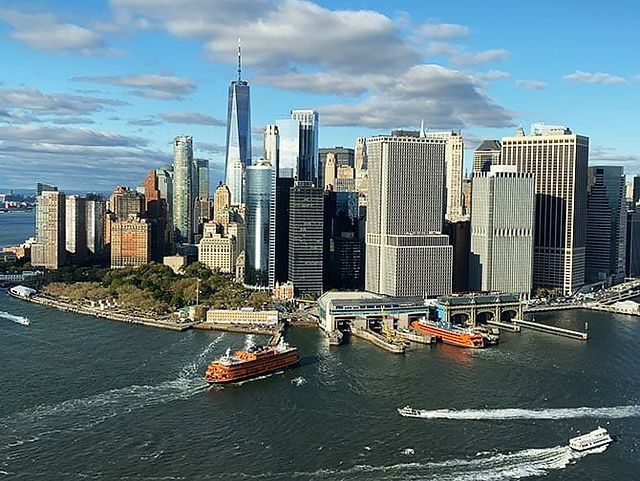
Water around New York City has risen about 9 inches since 1950 - Photo Reproduction / Internet
New York, the city that never sleeps, is at risk of sinking. According to a survey carried out by Oceanologists at the University of Rhode Island, working with a fellow USGS Moffett Field geologist, the Big Apple is sinking under the weight of its skyscrapers. The results of the research, published in the scientific journal "Earth's Future", show that the city is sinking at a rate of 1 to 2 millimeters per year. This may seem small, but over time, it can lead to serious consequences for the city's infrastructure and historic buildings.
The study
For a long time, scientists have observed the gradual sinking of most coastal cities due to settlement and lowering of the water table. An example of this is the city of New York, which experiences a continuous process of subsidence over the years and is likely to continue sinking in the future.
The current sinking is compounding the impact of sea level rise, which is accelerating at approximately twice the global average rate. This is due to the melting of glaciers around the world and the expansion of sea water caused by the global warming. The sea area surrounding New York City has already increased by about 22 cm since 1950. In addition, it is predicted that large floods, caused by storms, could be up to four times more frequent by the end of the century, due to a combination of rising sea levels and the intensification of hurricanes, resulting from climate change.
In this context, the research team identified a gap with regard to subsidence estimates for coastal cities such as New York, as few, if any, adequately consider the massive weight of buildings located in central areas. Aiming to overcome this limitation, the researchers undertook a new effort, in which they analyzed the weight contribution of all New York buildings and considered their impact on subsidence.
Research method
The researchers Pei-Chin Wu, Meng Wei, Steven D'Hondt, and Tom Parsons conducted a survey in which they calculated the total mass of buildings present in New York City. They then applied that data to models that predict natural subsidence in order to estimate the likely amount of global subsidence that will occur in the coming years.
The task was to count the buildings in New York City, estimate their weight, and then add them up. The researchers arrived at a total of 764 billion kilograms. Then they divided the city into a 100 by 100 grid to calculate the resulting pressure due to gravity. This load was then added to the natural weight of the soil, considering known conditions under New York City, primarily silt, sand, clay lake deposits, and some rock outcroppings. The team also took into account actual rates of subsidence over the last few decades, obtained through satellite measurements.
Upon completion, the model revealed estimates of subsidence rates in various areas of the city, also providing an overall average for the entire region - between 1 and 2 millimeters per annum. In addition, risk differences were identified between different parts of the city; for example, areas with soils rich in clay and with artificial fillings are more prone to subsidence, unlike deposits of sand or bedrock, which do not suffer subsidence.
“It's not something to panic about right away, but there is an ongoing process that increases the risk of flooding. The softer the ground, the more compression there is from the buildings. It wasn't a mistake to build such huge buildings in New York, but we have to keep in mind that every time you build something there, you press the ground a little bit harder," said Tom Parsons, a geophysicist who led the new research.
Subsidence is a geological phenomenon in which the earth's altitude decreases due to underground settling or removal of material or water, resulting in subsidence.
Conclusion
In 2012, New York City was impacted by the hurricane sandy, resulting in flooding in metro areas and widespread damage, including interruptions in electricity supply. Later, in 2021, the city was again affected by Hurricane Ida, which resulted in flooding in several areas and, unfortunately, caused the drowning of several people. According to scientists, both events were made worse by the effects of global warming.
Parsons emphasized the need for New York and other coastal cities to adequately prepare for this scenario. Frequent exposure to seawater has the potential to corrode steel and compromise the stability of buildings, something that is certainly not desirable. In addition, floods pose a deadly threat, which is undoubtedly the main concern to be faced.


