


James Webb Telescope first detects carbon molecule crucial to life in space

The presence of the methyl cation molecule (CH3+) was discovered in a protoplanetary disk located in a young star system in the Orion Nebula. The disk consists of gas and dust that forms around a star.
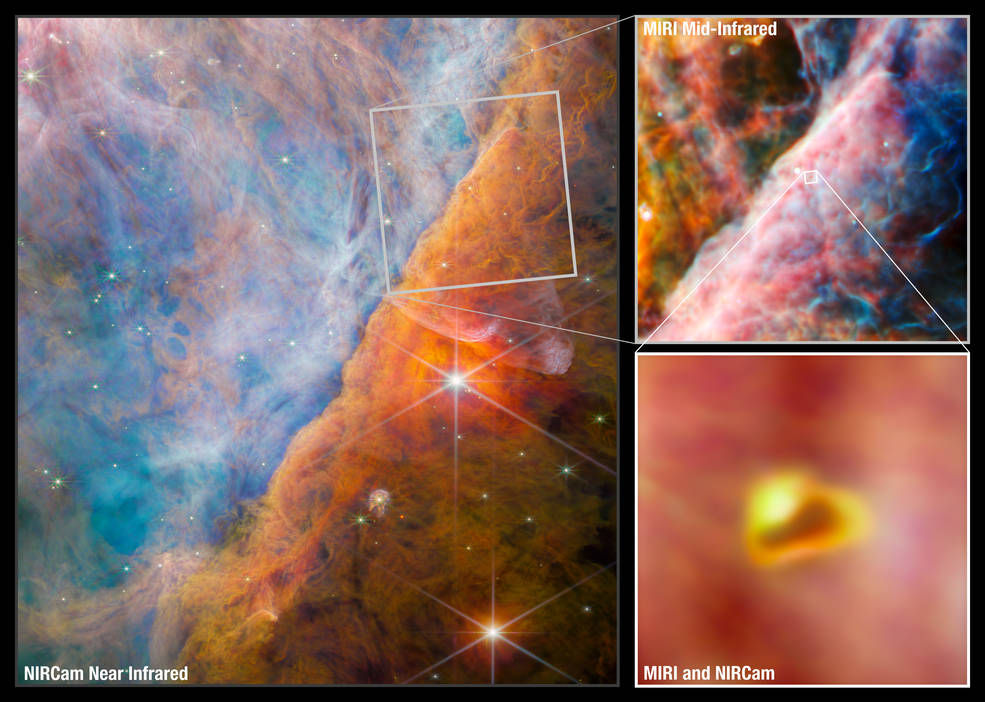
In the center of the area, there is a young star system with a protoplanetary disk called d203-506, located in the Orion Nebula.
NASA, an American Space Agency, released this Monday (26) that an international team of researchers used data collected by the James Webb Space Telescope to carry out the first detection of a carbon molecule in space. This molecule is an essential component for the formation of life.
Discovery
This discovery has the potential to direct research on the existence or development of life in other regions of the universe, considering that all known foundations of life are composed of carbon. The carbon compounds are the basis of all life known and, therefore, arouse a special interest in scientists who seek to understand how life emerged on Earth and how it could arise elsewhere in our universe. The exploration of interstellar organic chemistry, which involves carbon compounds, is a fascinating area for many astronomers, and Webb is breaking new ground in this field.
Molecule
A methyl cation molecule (CH3+) was detected in a protoplanetary disk, known as d203-506, which is formed by gas and dust around a star, located in a young star system in the Orion Nebula, located at a distance of 1,350 light years from the earth.
What do scientists say?
Webb has unique features that make it an ideal observatory for the search for this crucial molecule. Webb's extraordinary spatial and spectral resolution, along with its sensitivity, were key to the team's advancement. Specifically, Webb's detection of several important emission lines from CH 3+ cemented the discovery.
"This detection not only validates Webb's incredible sensitivity, but also confirms the postulated central importance of CH3+ in interstellar chemistry," said Marie Aline Martin Drumel of the University of Paris-Saclay in France, a member of the science team.
In space, the molecule has the ability to form an organic chemical base. The existence of this compound in this area of the universe can be explained by the constant exposure to intense ultraviolet radiation emitted by other stars, which bombard the star system. There is evidence to suggest that a similar phenomenon occurred in our own Solar System during its formation.
According to Drumel, although the star in d203-506 is a small red dwarf, the system is constantly exposed to intense ultraviolet (UV) radiation from nearby young, hot, massive stars. The researchers support the hypothesis that most planet-forming disks go through a stage of intense exposure to UV radiation, since stars tend to form in clusters that often include massive stars with high UV emission.


