
Get Ready for the Show: T Coronae Borealis' rare starburst could happen at any time; See how to observe

The star in the constellation Corona Borealis will experience a nova-type eruption, a rare event that only occurs every 80 years. To locate T Coronae Borealis in the sky, stargazing apps for cell phones are useful, as they allow you to identify various astronomical objects.
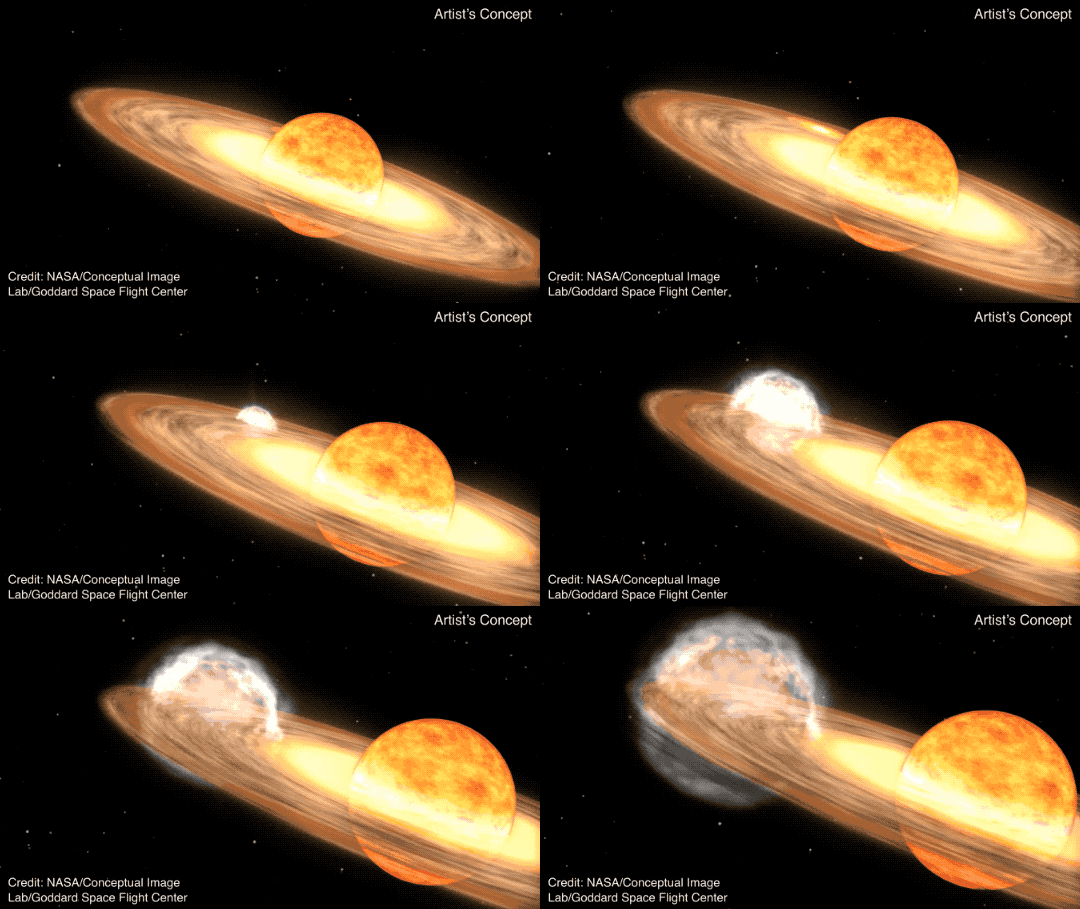
The explosion of T Coronae Borealis will be visible to the naked eye - Photo Reproduction/NASA
The eyes of astronomers and astronomy enthusiasts will have a unique opportunity for a rare and spectacular event in the coming weeks: the stellar explosion of T Coronae Borealis (T CrB), which could occur at any time until at least next September. Located in the Corona Borealis constellation, this cataclysmic variable star has the potential to light up the sky in a dazzling and unexpected way. This binary system, located approximately 3,000 light-years from Earth, is about to emit an explosion so bright that it will be visible to the naked eye.
According to Rebekah Hounsell, an assistant research scientist specializing in events of this type at NASA's Goddard Space Flight Center, the US space agency, this is a once-in-a-lifetime event that will inspire many new astronomers. It will offer young people the chance to observe a cosmic phenomenon, formulate their own questions and collect their own data.
What is the T Corona Borealis?
T Coronae Borealis, also known as the "Blazing Star of the North", is a new recurring character. This means that she is a binary star made up of a red giant and a white dwarf. In the white dwarf star, we find the dense core of a now-deceased star, the size of Earth, but with a mass similar to that of our Sun. but its diameter is about 100 times smaller. Around it, an aging red giant is gradually being sucked into the white dwarf's intense gravitational pull.
NASA, the North American space agency, explains that this system of two stars is known for its periodic explosions, when the surface of white dwarf accumulates hydrogen of the red giant increasing pressure and heat, until reaching a critical point, resulting in a new – a thermonuclear explosion on the surface of the white dwarf. In the case of T CrB, this phenomenon appears to occur approximately every 80 years. Therefore, observing this event, known as "new" among scientists, will be a unique opportunity.
Hounsell also explained that it is important not to confuse a nova with a supernova. A supernova is a powerful explosion that marks the end of some stars. During this event, a white dwarf can survive, expelling accumulated material into space in a luminous spectacle. This cycle can repeat itself over millennia.
A History of Explosions
T CrB has had visible flares twice in the past – once in 1866 and once in 1946, in addition to historical accounts mentioning sightings in 1787 and 1217. During these flares, the star's brightness increased dramatically, becoming visible to the naked eye. This phenomenon generates significant interest in the astronomical community, as it provides valuable information about the physics of recurring novae and mass transfer processes between binary stars.
According to NASA experts, in most cases it is not possible to predict when nova explosions will occur. However, approximately 10 of these are known as "new recurrents". NASA predicts T CrB will explode based on mathematical calculations and visible evidence. An additional indication that T CrB is close to exploding is the decrease in its brightness for about a year, specifically starting in March 2023. Therefore, scientists determined that it should explode by the end of September.
Why the Expectation Now?
T Coronae Borealis stands out among other new stars due to its reliable burst periodicity, a unique phenomenon among the many novae identified over the years. This unique feature makes its stellar explosion especially notable. Many new ones have been discovered, but most do not have a known recurrence, some going very long periods without subsequent explosions, which makes it difficult to predict their next event.
Normally, the Corona Borealis star system has a visibility magnitude of +10, according to information from NASA. However, during a T CrB nova explosion, its visibility increases significantly to about magnitude +2, a brightness considerably greater than +10. In comparison, +2 is similar to the brightness of the North Star, making T CrB visible to the naked eye during the explosion event.
How to Observe the Phenomenon

Image generated by planetarium software illustrates how to locate the constellation Corona Borealis in the sky. - Photo Reproduction/Nasa
If T CrB does explode, it will be a unique opportunity for amateur and professional observers. To find T Coronae Borealis in the sky, you can use stargazing apps on your cell phone, such as Star Walk 2 or Sky Tonight. These applications allow you to identify various astronomical objects. Just type "T CrB" in the app's search tool and point your phone at the night sky. Here are some tips to ensure you don't miss this celestial spectacle:
Location and Equipment: T CrB is located in the constellation Corona Borealis, visible in the northern hemisphere. For naked eye observation, look for a dark place, away from city lights. Binoculars or small telescopes can enhance the experience.
Constant Monitoring: Keep an eye on updates from observatories and amateur astronomy. There are apps and websites dedicated to skywatching that can provide real-time alerts.
Climate conditions: Check the weather forecast to ensure the sky is clear during observing nights. Clouds can obstruct the view of the phenomenon.
Register your Observation: Photographing or filming the event can be an exciting way to document your experience. Use cameras with good light sensitivity and, if possible, astronomical photography equipment.


