


From Magnata da Banana to President: The Journey of Daniel Noboa in Ecuador

Right-wing millionaire Daniel Noboa, almost unknown in politics, surprised by winning the second round of Ecuador's presidential elections on Sunday.
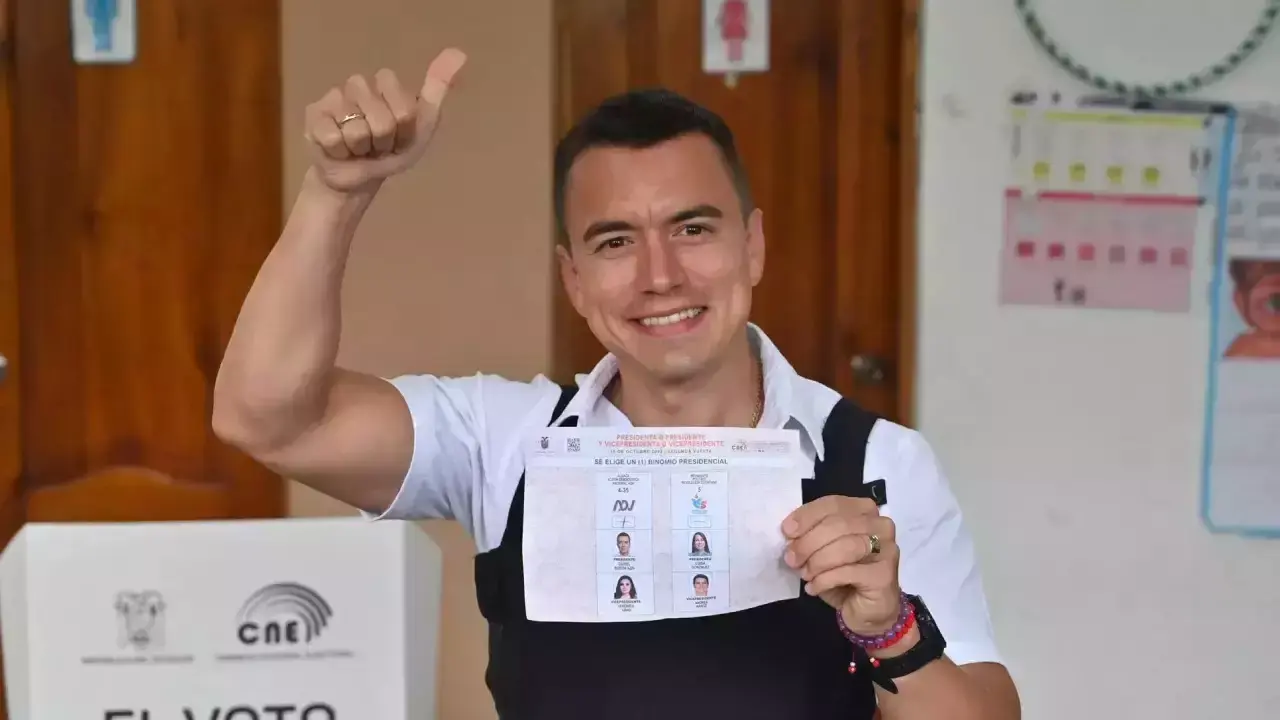
Daniel Noboa from the National Democratic Action Alliance party - Photo Reproduction/Social Networks
Ecuador's political landscape has undergone notable shifts and upheavals in recent months. A remarkable story of transformation and ascension is the trajectory of Daniel Noboa, a successful businessman in the banana sector who now holds the position of president of Ecuador. With a center-right political orientation, Daniel Noboa, aged 35, won the Ecuadorian elections held on Sunday (15), thus becoming the youngest president in the country's history.
Nobody's victory marked the end of a tense and violent election campaign in Ecuador. This campaign was marked by the murder of one of the candidates, threats linked to drug trafficking and even presidential candidates having to vote wearing bulletproof vests under strict security.
According to the announcement of National Electoral Council (CNE) from Ecuador, Daniel Noboa, from the National Democratic Action coalition, triumphed in the second round with 52.3% of the votes, surpassing lawyer Luisa González, proven by former president Rafael Correa, who obtained 47.7% of the votes. Favored in polls throughout the campaign, González conceded defeat.
As Origins by Daniel Noboa
Daniel Noboa Azín was born in Guayaquil, the largest city in Ecuador, on November 30, 1987. He was born in a notable family of entrepreneurs who own a vast business empire. This empire includes the renowned Bonita Banana Exporter, one of the most important in the country. Daniel is currently married to influencer and model Lavinia Valbonesi, who is 25 years old.
The patriarch of his family, Luis Noboa Naranjo (1916-1994), was the visionary founder of Noboa Banana Exporter and achieved the status of the wealthiest man in Ecuador. Daniel's father, Álvaro Noboa Pontón (born in Guayaquil in 1950), expanded the family business empire beyond the banana sector, taking control of a network multinational company under the banner of Grupo Noboa. However, the family's economic success was often marked by comments of tax evasion and labor exploitation.
From Magnata da Banana to Politico
Álvaro Noboa was a pioneer in entering politics, which was a common practice among families with economic influence in Ecuador, especially in Guayaquil, the country's main commercial city. However, Álvaro's aspiration to achieve the presidency proved fruitless. His father, who tried to become president of the country in five elections, was also unsuccessful. In 2006, he came close to his goal, but lost in the second round to Rafael Correa, who led Ecuador until 2017.
Daniel Noboa, on the other hand, followed a different academic path. He studied at renowned universities in the United States, obtained degrees in business administration from New York University, public administration from the Harvard Kennedy School, in addition to completing a master's degree in Governance and Political Communication from George Washington University.
Interestingly, even after founding an event organization company called DNA Entertainment Group At the age of 18, Daniel entered politics late. His debut only occurred in 2021, when he was elected deputy, and subsequently appointed to the presidency of the Economic Development Commission in Parliament.
The Campaign and the Election
After dissolution of Parliament and the activation of what is called "death crusade" (which involves the dissolution of the Assembly and the calling of new elections) by President Lasso in May, Noboa emerged as a pre-candidate with a notably different profile from his father. For example, while his father was positioned on the political right, Daniel claimed to be aligned with the center-left, defending progressive ideas of a social nature, such as support for the LGBTQIA + community and an emphatic commitment to improving education.
His campaign is also based on his business experience and promises of modernization and economic development, as well as a commitment to strengthening the health system and guarantees so that Ecuador is better prepared to face future crises. A few days before the first round, on August 20, few believed that Noboa had a real chance of advancing to the final dispute. However, everything changed in the decisive debate, when he faced Luisa González and other candidates who were considered favorites.
Government Challenges
There is a consensus among analysts that Noboa will face significant challenges as it moves forward with its proposals. To achieve his objectives, he will depend on the support necessary to win a majority in the National Assembly, a highly fragmented 137-member body. Their Citizen Revolution rivals hold the majority of seats, although they are still far from reaching the majority needed to veto the proposals.
Noboa plans to legislate through negotiations focusing on the essential elements of the laws and intends to present urgent bills monthly to exert pressure on the Assembly. This demonstrates his awareness that, as the new president, he has only a year and a half to face the clear challenge of resolving the considerable and increasingly serious political, economic and, above all, security problems facing Ecuador.


