


Elections in Ecuador; Voters go to unities, after campaign marked by candidate's murder

Ecuador is holding early voting after incumbent President Guillermo Lasso dissolved the National Assembly and called a new election. The electoral campaign was largely marked by the issue of violence. Security has been in the spotlight since the tragic assassination of Fernando, one of the presidential candidates.

Ecuadorian voters come to choose a new president and legislators in the country - Photo Reproduction / Internet
The Ecuadorians are exercising their right to vote this Sunday (20) in the first round of presidential elections and in the selection of members of the country's National Assembly. Its election was marred by tragic events, including the murder of Fernando Villavicencio, one of the candidates, and other violent incidents. Competing candidates have committed themselves to dealing with the drastic increase in crime, which the current government attributes mainly to drug trafficking gangs, as well as seeking solutions to the technological challenges plaguing the country. These problems generated a significant increase in unemployment and emigration.
Voting in Ecuador began at 9:00 am, Brasilia time, and is expected to end at 7:00 pm, also at Brasilia time.
Violence
The issue of security has become the main focus of attention since the tragic murder of anti-corruption advocate Fernando Villavicencio, which took place on August 9 during a rally in the city of Quito. Before entering politics, Villavicencio was an investigative journalist and activist. Police authorities detained six individuals suspected of involvement in the crime, while a seventh died during a shootout. It is important to highlight that all suspects belong to gangs of Colombian nationality.
In addition to the tragic murder of candidate Villavicencio, other violent incidents occurred, such as the assassination of a party leader a few days later. In addition, another candidate claimed to have been the victim of an attack, although the police authorities denied the existence of such an attack. Months before the early presidential election was called, a mayoral candidate also lost his life in a violent manner.
Candidates
Other competitors mentioned being the target of attacks, although on several occasions the police stated that the violence was not aimed at the competitors themselves. Villavicencio's candidacy was taken over by a friend, Christian Zurita. Villavicencio's name will still appear on the ballots, but candidates will be informed that the vote will count for Zurita. Under Ecuadorian law, vice-presidential candidate Andrea González cannot take the running mate position.
Zurita attended the polling station with asubstantial security scheme, a helmet and bulletproof vest. Zurita, pledged to improve the police apparatus and implement more effective intelligence protocols in the fight against crime, planning to use international loans to strengthen social programs.

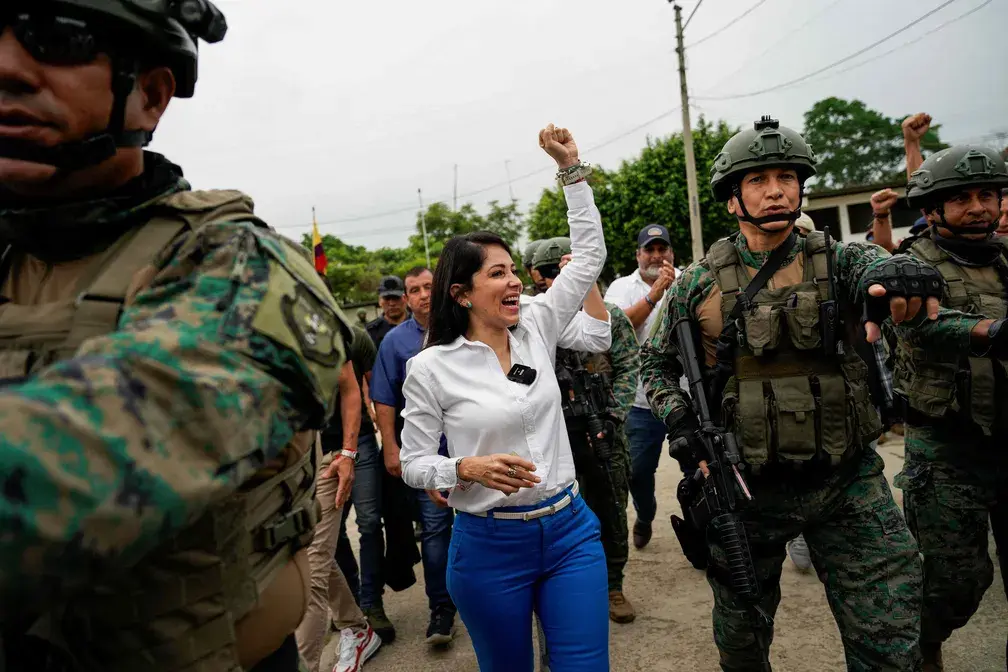
Christian Zurita, left and Luisa Gonzalez, right - Photo Reproduction/Reuters
Presidential candidate Luisa Gonzalez also cast her vote during the morning. Monica Barba, candidate from the party of former president Rafael Correa, expressed deep concern about the country's current trajectory, noting that it is deteriorating due to mismanagement, and expressed the hope that his party would emerge victorious. Before the tragic murder of Villavicencio, Luisa González, supported by Correa, led the polls with approximately 30% of the voting intentions.
She pledged to release $2.5 billion from international reserves to shore up Ecuador's economy and reintroduce social programs implemented by Correa during his decade in power, despite his memory for corruption.
The pro-market candidate Otto Sonnenholzner adopted a more rigid tone in his speech since the murder of Villavicencio. He has repeatedly stated that under his rule, the police will take strong action against criminals who resort to violence, including the use of deadly force.
Law-and-order candidate Jan Topic, who claims to have been a member of the French Foreign Legion, pledged to adopt security issues as its top priority. Meanwhile, Daniel Noboa, son of prominent businessman Álvaro Noboa and former candidate, focused his campaign on job creation. The postulant environmentalist of indigenous origin, Yaku Perez, announced his intention to reassess the mineral exploration permits that are not in compliance with environmental and social standards, while also seeking funds to obtain financial relief.
Early elections
Approximately three months ago the current president of Ecuador, Guillermo Lasso, faced impeachment proceedings, marking the first in Ecuador's recent history. Due to his fragile base in the Legislature, Lasso opted to dissolve Congress and call new presidential elections. This act of dissolving the National Assembly and calling early elections is known as "cross death". Lasso had been elected in April 2021, and his party won 12 seats in Parliament. Meanwhile, Correísmo, the main left-wing force in the country, had 48 deputies. himself, Lasso chose not to participate.
Vote
Also on Sunday, there were two environmental referendums, both requiring approval, which have the potential to prevent the exploitation of mineral resources in a forest near the capital, Quito, as well as the development of an oil field in the Amazon region. The 13 million consumers will also have the responsibility of choosing 137 members of the National Assembly. Voting is mandatory for citizens between the ages of 18 and 65, and authorities have ensured the presence of 100,000 police and military personnel to ensure the security of polling places.
Voting will close at 17:00 (22:00 GMT), and preliminary results are expected to be released a few hours after closing. To win in the first round, a candidate needs to get 50% of the vote, or a minimum of 40% of the vote, provided he is ahead of his nearest rival by at least 10 percentage points. If not, a second round will be held on October 15th.


