
Deforestation in the Amazon records the lowest rate in the last 6 years in the first two months, reveals Imazon

Between January and February 2024, the deforested area in the biome totaled 196 km², which marks a significant reduction of 63% compared to the same period last year.
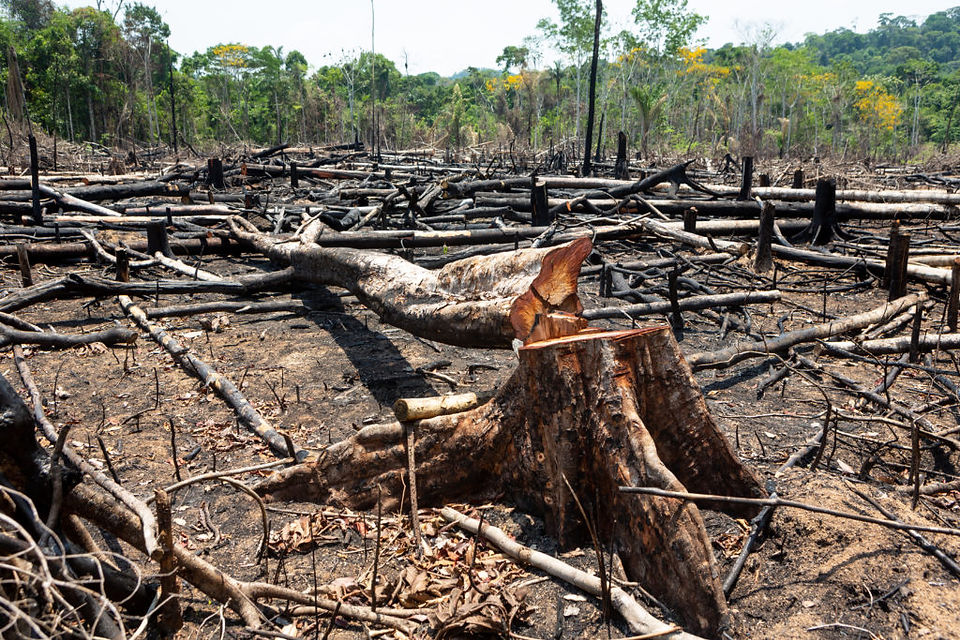
Deforestation in the Amazon forest recorded the lowest rate in the last six years during the first two months/ Photo Reproduction/Adobe Stock
In the environmental scenario, the Amazon has always occupied a central place of concern due to its inestimable ecological value. Data released by the Amazon Institute of Man and Environment (Imazon) this Monday (18) brought promising news: deforestation in the Legal Amazon recorded the lowest rate in the last six years during the first two months of 2024. The Legal Amazon covers around 59% of Brazil's territory and comprises nine states: Acre, Amapá, Amazonas, Mato Grosso, Pará, Rondônia, Roraima, Tocantins and a portion of Maranhão. This discovery marks a potential turning point amid the worrying trend of forest degradation that has plagued the region in recent years.
The drop in deforestation rates
According to Imazon data, deforestation in the Legal Amazon totaled approximately 196 km² in the months of January and February, representing a significant drop in63% compared to the same period last year, when an extension of 523 km² of forest in the biome was deforested, corresponding to an area equivalent to the size of Brasília. This decrease places the deforestation rate at the lowest level recorded since the first months of 2018.
The information comes from the institute's Deforestation Alert System (SAD), whose approach differs from the methodology used by Deter, from the National Institute for Space Research (INPE). According to Imazon, the satellites used have superior precision compared to government systems, being able to identify deforested areas from 1 hectare onwards. On the other hand, INPE's alerts consider areas larger than 3 hectares.
Imazon
Imazon developed the Deforestation Alert System (SAD) in 2008, a tool that uses satellite images to identify deforested areas throughout the Legal Amazon. Using NASA's Landsat 7 and 8 satellites, along with the European Space Agency's (ESA) Sentinel 1A, 1B, 2A and 2B, SAD is able to observe the same region every 5 to 8 days. These satellites, in the public domain, allow any person or institution to access the data.
The system prioritizes the analysis of images acquired in the last week of each month, allowing recent changes to be detected. This means that areas that were degraded at the beginning of the month and deforested at the end can be identified as deforestation in the final data. Similar to Inpe Deter, the SAD monitoring calendar runs from August of one year to July of the following year, due to the lower frequency of clouds in the Amazon during this period. Both systems are designed as alerts, but are not considered official deforestation data.
Possible causes and contributions
Several factors may be contributing to this reduction in deforestation rates. Public policies aimed at environmental preservation, such as more effective enforcement operations and satellite monitoring initiatives, may be playing a crucial role. In addition, awareness about the importance of the Amazon and the impact of deforestation practices may also be positively influencing government and civil society actions.
During this period, forest suppression remained below 150 km² in all years, as observed through the institute's satellite image monitoring. To highlight the magnitude of deforestation in the Amazon in the months of January and February 2024, it is notable that the deforested area exceeds the territories of three Brazilian capitals: Vitória (97 km²), Natal (167 km²) and Aracaju (182 km²).
This data highlights the substantial challenge we face. Achieving the zero deforestation target set for 2030 is of paramount importance to combat climate change. For that, One of the government's main priorities should be to accelerate the ongoing processes of demarcating indigenous and quilombola lands, as well as the creation of conservation units, as historically these are the territories with the lowest incidence of deforestation in the Amazon.
Challenges and continuity of efforts
Despite the positive news, Imazon warns that deforestation in the first quarter of 2024 still exceeds the levels observed in the same months between 2008 and 2017, with the exception of 2015. Although the most recent figures are a reason for optimism, It is important to maintain a realistic perspective on the challenges that persist. The Amazon continues to face threats such as illegal logging, unsustainable agricultural activities and the invasion of indigenous lands. Additionally, climate change and economic pressures could complicate long-term conservation efforts.
Classification of Deforestation by State in the Legal Amazon
In the first two months of 2024, the analysis of deforestation in the states that make up the Legal Amazon reveals that Mato Grosso leads with 32%, followed by Roraima with 30% and Amazonas with 16%. These numbers represent a total of 152 km² of devastated forest, which is equivalent to 77% of the deforestation recorded in the region during this period. According to the Imazon Institute, in Mato Grosso, deforestation was driven mainly by the expansion of agricultural activity, notably municipalities such as Feliz Natal, Nova Maringá, Juína, Juara, Marcelândia and Canarana.
In Roraima, deforestation has advanced even in indigenous lands, with eight territories listed, including Yanomami, Manoá-Pium and Raposa Serra do Sol. In the Amazonas, there is an increase in deforestation in settlement areas, with the municipalities in the South region those most impacted by this activity.
The role of society and public power
Given this context, it is crucial that society continues to press for measures that protect the Amazon and its communities. The active engagement of public authorities, together with the participation of civil society and the private sector, is essential to ensure that recent advances in reducing deforestation are sustainable and lasting.


