
Crisis in Bolivia: Military personnel attempt a coup d'état and invade the presidential palace, but the action is quickly demobilized

The attempted coup d'état was led by a former Army commander, who had been removed for threatening former president Evo Morales. In response, the president of Bolivia, Luis Arce, made a statement in which he dismissed the heads of the Armed Forces. The new military commander ordered the demobilization of tanks and soldiers.
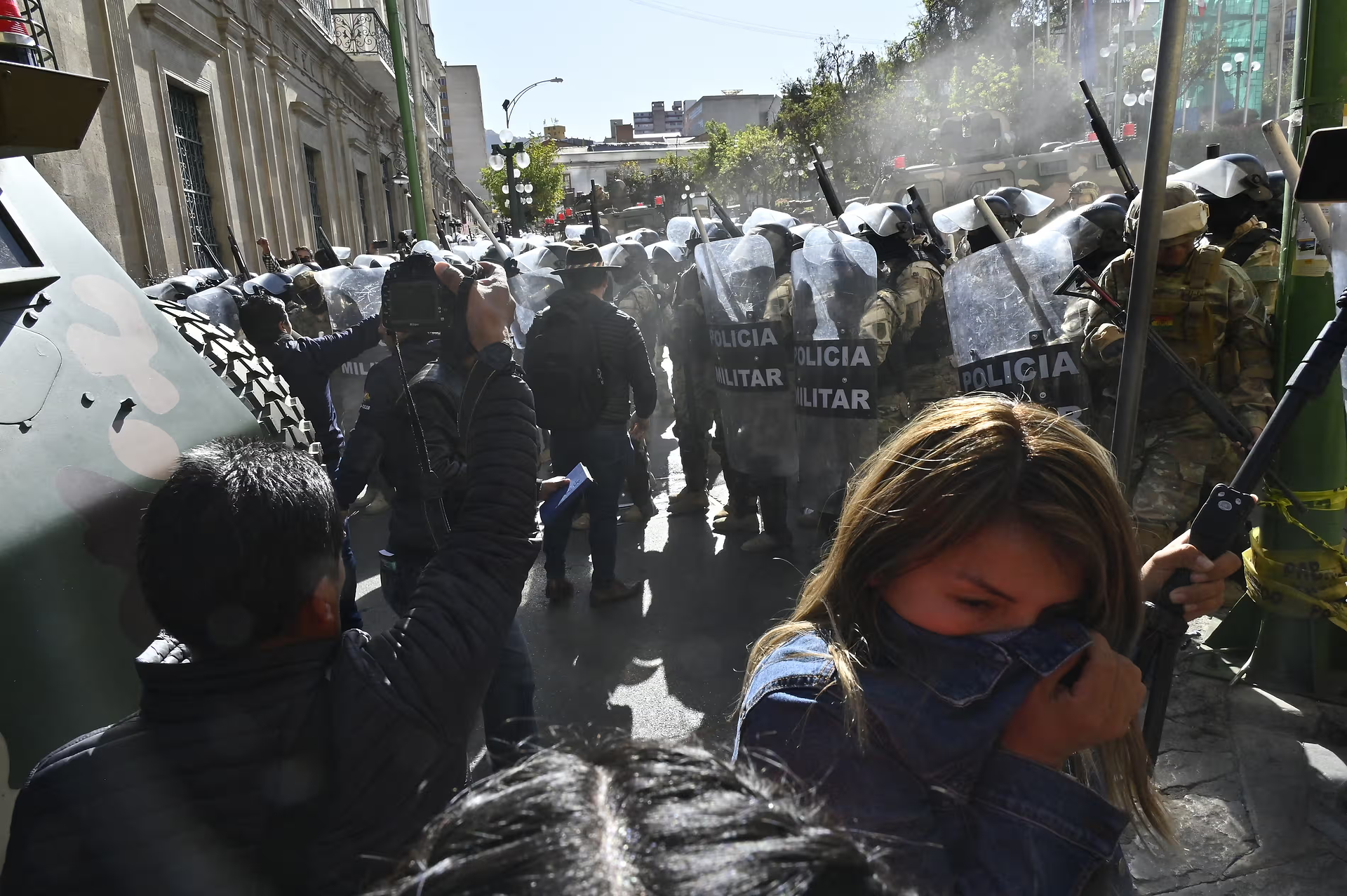
A woman escaped tear gas fired by military troops in front of the Quemado Palace, located in La Paz, Bolivia, this Wednesday – Photographic Reproduction/Aizar Raldes/AFP/Getty Images
This Wednesday (26), Bolivia witnessed moments of high political tension, after the Bolivian military attempted a coup d'état led by the country's former army commander. The presidential palace in La Paz, which is currently used for formal events, was invaded by Army tanks and armed soldiers. The action was quick and energetic, but it was promptly demobilized by forces loyal to the constitutional government.
So far, it is known that Bolivian President Luis Arce and former President Evo Morales have mentioned a possible coup d'état. In a statement on social media, Arce also appealed for respect for democracy. There were reports that Army units gathered in squares and streets in the capital. According to witnesses from the Reuters news agency, an Army tank was seen entering the presidential palace in La Paz. Arce declared today that the Bolivian Armed Forces are carrying out "irregular mobilizations".
The Political Context
In the last five years, Bolivia has faced turbulent periods in its politics. In 2019, Evo Morales' third term was abruptly interrupted by a coup d'état, triggered by a protest movement and strikes that involved popular, middle-class and business sectors. Evo, recently elected in the first round of October's presidential elections for a fourth term without adequate institutional support, resigned from the presidency and left the country.
After Morales' departure, Jeanine Áñez proclaimed herself interim president of Bolivia. She and supporters of the coup were arrested in 2021, including former Bolivian Army commander Jorge Pastor Mendieta Ferrufino, leader of the 2019 coup, according to the Bolivian Information Agency. In 2008, there was another coup attempt that failed. The Bolivian government denounced a "civil coup" initiated by the conservative opposition in Santa Cruz, but ruled out declaring a state of siege to ease political tension.
Arce and Evo Morales, who were allies, are now opponents due to the 2025 presidential elections. Morales will be the candidate of MAS, the government party of which he is leader. Arce was removed by MAS for refusing to participate in the congress held between Tuesday and Thursday in Cochabamba.
Attempted Coup
The government stated that the coup attempt was led by general Juan José Zuñiga, who was removed as army commander due to threats made to former president Evo Morales, including the promise to arrest him if he returned to power. After approximately four hours of tension, which included a direct confrontation between President Luis Arce and Zuñiga, the movement was disbanded by order of the president himself, and the military withdrew from the scene. In the statement, Luis Arce announced the removal of the general and the commanders of the Navy and Air Force, designating new leaders for the forces and instructing the demobilization of the troops.
Zuñiga, a controversial figure, had been at odds with the government in recent months. On Monday (24), his statements gained intensity when he stated that he would arrest Evo Morales, candidate in the next elections, if he were elected again. On Tuesday (25), senators announced legal proceedings against the former Army commander. The president fired the other two commanders of the Armed Forces.
According to the Reuters news agency, the new commander ordered the withdrawal of troops, resulting in the tanks leaving the presidential palace and Murillo Square, in front of the palace. Zuñiga, present in Murillo square, told local broadcasters that this movement aimed to "restore democracy" in Bolivia and free political prisoners. After the invasion, Arce confronted Zuñiga directly at the entrance to the presidential palace. During the discussion, the president ordered the former Army commander to demobilize his troops. Furthermore, Bolivia's Supreme Court strongly condemned the coup attempt and called on the international community to remain vigilant and support democracy in Bolivia.
Former President of Bolivia Evo Morales, who broke with Luis Arce last year, although both are part of the same political movement, stated that the current event is a coup d'état. Morales accused an Army regiment of positioning snipers in a La Paz square and held General Juan José Zuñiga responsible for the mobilization. He called for a national mobilization in defense of democracy against what he describes as a coup d'état plotted by General Zuñiga, emphasizing that he will not allow the Armed Forces to violate democracy or frighten the people.
In a statement, Zuñiga mentioned that there would be changes, but did not confirm the occurrence of a coup d'état. In an interview with a local television station, he declared: "The three heads of the Armed Forces came to express our dismay. There will be a new cabinet of ministers; certainly, there will be changes, but our country cannot continue in this situation."
International repercussions
The international community, including neighboring countries and regional organizations such as the OAS (Organization of American States), reacted with concern to the escalation of the crisis in Bolivia. Calls for moderation and respect for the constitutional order were made by several world leaders and international organizations. President Luiz Inácio Lula da Silva (PT) expressed support for Luis Arce and strongly condemned any coup attempt. He stated that Brazil's position is unequivocal: "I am a defender of democracy and I want it to prevail throughout Latin America. We categorically condemn any coup d'état in Bolivia and reiterate our commitment to the people and democracy in this sister country."
The president of Honduras, currently leading the presidency of the Community of Latin American and Caribbean States (CELAC), mentioned the possibility of a coup d'état and requested an emergency meeting of member states, including Brazil. The OAS criticized this action and emphasized the importance of respect for democracy. The former president of Bolivia, Jeanine Añez, currently in opposition to Arce's government, also condemned the military intervention.
"Total repudiation of the mobilization of military personnel in Murillo Square (in front of the presidential palace) intending to destroy the constitutional order," he said. "We Bolivians defend democracy."
In a statement released on his social networks, Arce also emphasized the importance of respect for democracy. President Lula expressed his desire for democracy to prevail in the neighboring country, stating that "coups have never worked." Itamaraty declared that The Brazilian government is closely following events in Bolivia.


